I run AhrefsAlternative.com because I got tired of watching freelancers, bloggers, and small business owners pay $129 to $449 a month for a tool whose full power they never touched. Ahrefs is genuinely impressive - but most people using it for keyword research are paying for a fighter jet when they need a reliable car. This guide is my honest answer to the question I get every week: "What should I actually use instead?"
All pricing was verified in October 2026 from each tool's official pricing page. I tested every paid tool listed here on live client sites. Where I cite ratings, I link directly to G2 or Capterra. This site earns affiliate revenue from some of the tools listed, but that has zero influence on rankings - you'll see why when you read the evaluation rubric below.
If you're completely new to keyword research, start with the Keyword Research Without Ahrefs: Beginner's Guide first, then come back here to pick your tool. For a broader comparison that goes beyond keyword research, the Best Ahrefs Alternatives in 2026 (Tested) covers the full feature set of each platform.
Jump to your budget tier:
- Free Tools
- Under $30/month
- $30–$100/month
- $100+/month
Ahrefs Pricing in 2026 - and Why Most Users Are Overpaying
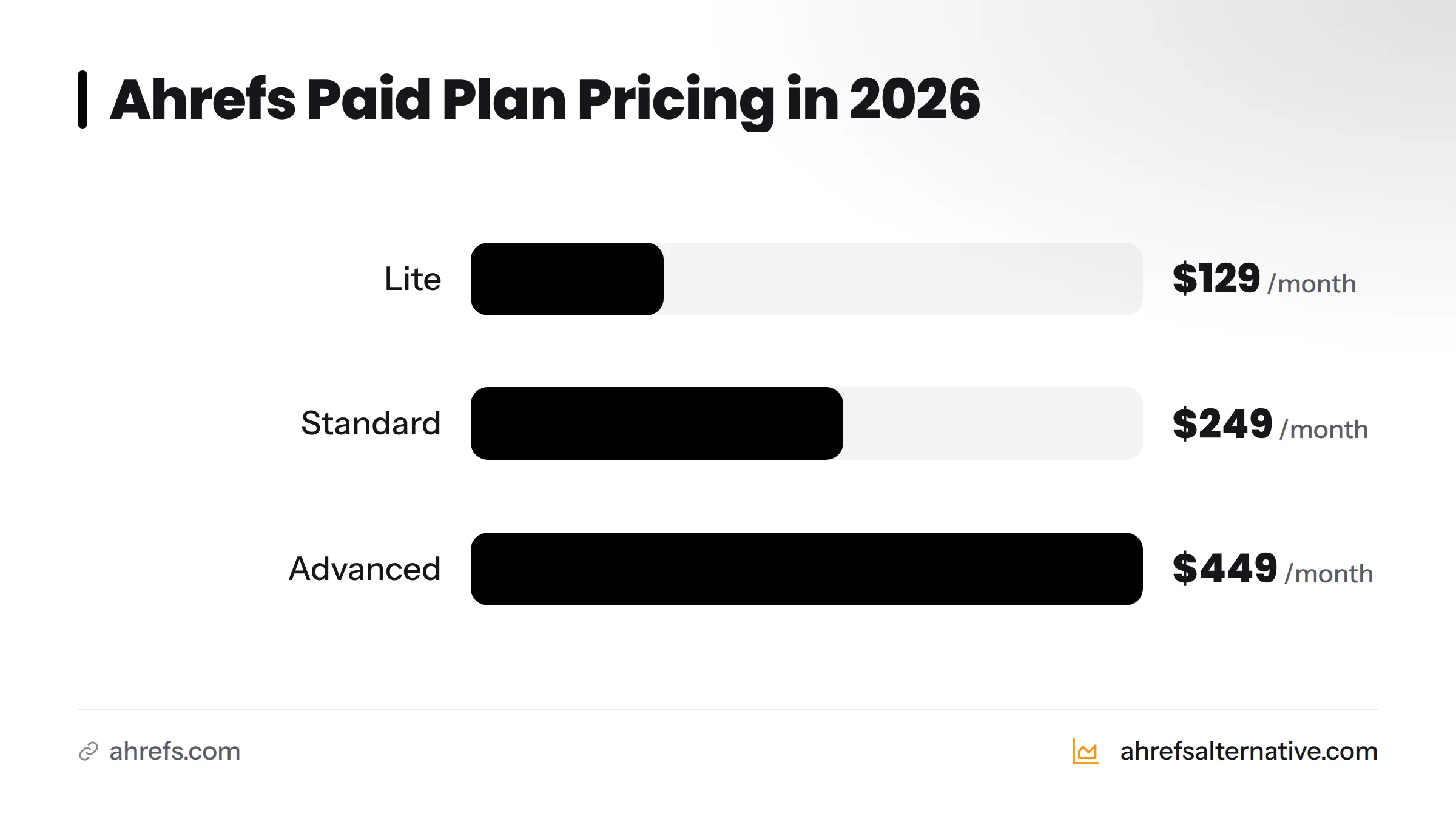
According to the official Ahrefs pricing page, Ahrefs offers four paid plans: Lite at $129/month, Standard at $249/month, Advanced at $449/month, and custom Enterprise pricing. There is no meaningful free plan - Ahrefs Webmaster Tools is free but limited to your own verified domains and doesn't give you the broad keyword research capability most users picture when they sign up.
For a solo blogger running one site, $129/month is a hard ask. For a freelancer managing three client sites, the $249/month Standard plan only makes financial sense when clients are paying enough to absorb it. For a startup founder doing their own SEO, it's simply the wrong spend at the wrong stage.
You can read a full breakdown in the Ahrefs Review: Are There Other Alternatives? piece on this site. The short version: Ahrefs is priced for agencies and in-house SEO teams with serious budgets. Everyone else is overpaying.
What a Keyword Research Tool Actually Needs to Do
A keyword research tool, at its core, needs to do five things well:
- Show search volume - how many people search a term per month
- Score keyword difficulty (KD) - how hard it is to rank for a term
- Surface long-tail variations - related, lower-competition keyword ideas
- Reveal search intent - are searchers looking to buy, learn, or navigate?
- Preview the SERP - who is ranking, and how strong are their pages?
Rank tracking, site audits, full backlink analysis, and content gap reports are all genuinely useful. But for pure keyword research, you don't need Ahrefs' full suite. You need a tool that nails those five capabilities at a price that makes sense for your stage of growth.
What to Look for in an Ahrefs Alternative for Keyword Research
The right alternative depends on your workflow, but every serious contender should offer:
- A keyword database covering your target geography with fresh data (updated at least monthly)
- A keyword difficulty score that accounts for the real competitive landscape, not just domain authority
- Long-tail keyword discovery through autocomplete expansion, question-based keywords, and related terms
- At minimum, a basic SERP overview for any queried keyword
- Export capability - you need to own your data
- A free tier or trial, so you can test before committing
How These Tools Were Evaluated
Every tool in this guide was scored against six criteria on a 1-10 scale. Here is the rubric:
| Criterion | What It Measures | Weight |
|---|---|---|
| Keyword Database Size | Number of keywords indexed; geographic coverage | High |
| KD Accuracy | How well the difficulty score predicts real ranking effort | High |
| Long-Tail Discovery | Quality and depth of related keyword suggestions | High |
| Ease of Use | Learning curve; interface clarity for non-experts | Medium |
| Price / Value | Cost relative to features delivered | High |
| Unique Features | Anything that genuinely differentiates the tool | Medium |
Tools were tested on real domains across content, e-commerce, and service niches. For a deeper look at how to apply this framework yourself, see How to Compare SEO Tools Like Ahrefs.
Best Alternatives to Ahrefs for Keyword Research - Quick Comparison
The table below covers all 13 tools reviewed in this guide. "KD Accuracy" is a relative score based on our testing; "Ease of Use" reflects the learning curve for a non-expert user.
| Tool | Best For | Free Tier? | Starting Price | KD Accuracy | Ease of Use | Our Rating |
|---|---|---|---|---|---|---|
| Ahrefs Alternative | All-in-one comparison hub | Yes | Free | - | Excellent | ⭐⭐⭐⭐⭐ |
| Ahrefs Webmaster Tools | Auditing your own site | Yes (own site only) | Free | Excellent | Good | ⭐⭐⭐⭐ |
| Google Search Console | Free keyword data | Yes | Free | N/A | Excellent | ⭐⭐⭐⭐ |
| Google Keyword Planner | Search volume data | Yes (with Ads account) | Free | N/A | Good | ⭐⭐⭐ |
| Ubersuggest | Free keyword ideas | Yes (3 searches/day) | $29/mo | Good | Excellent | ⭐⭐⭐ |
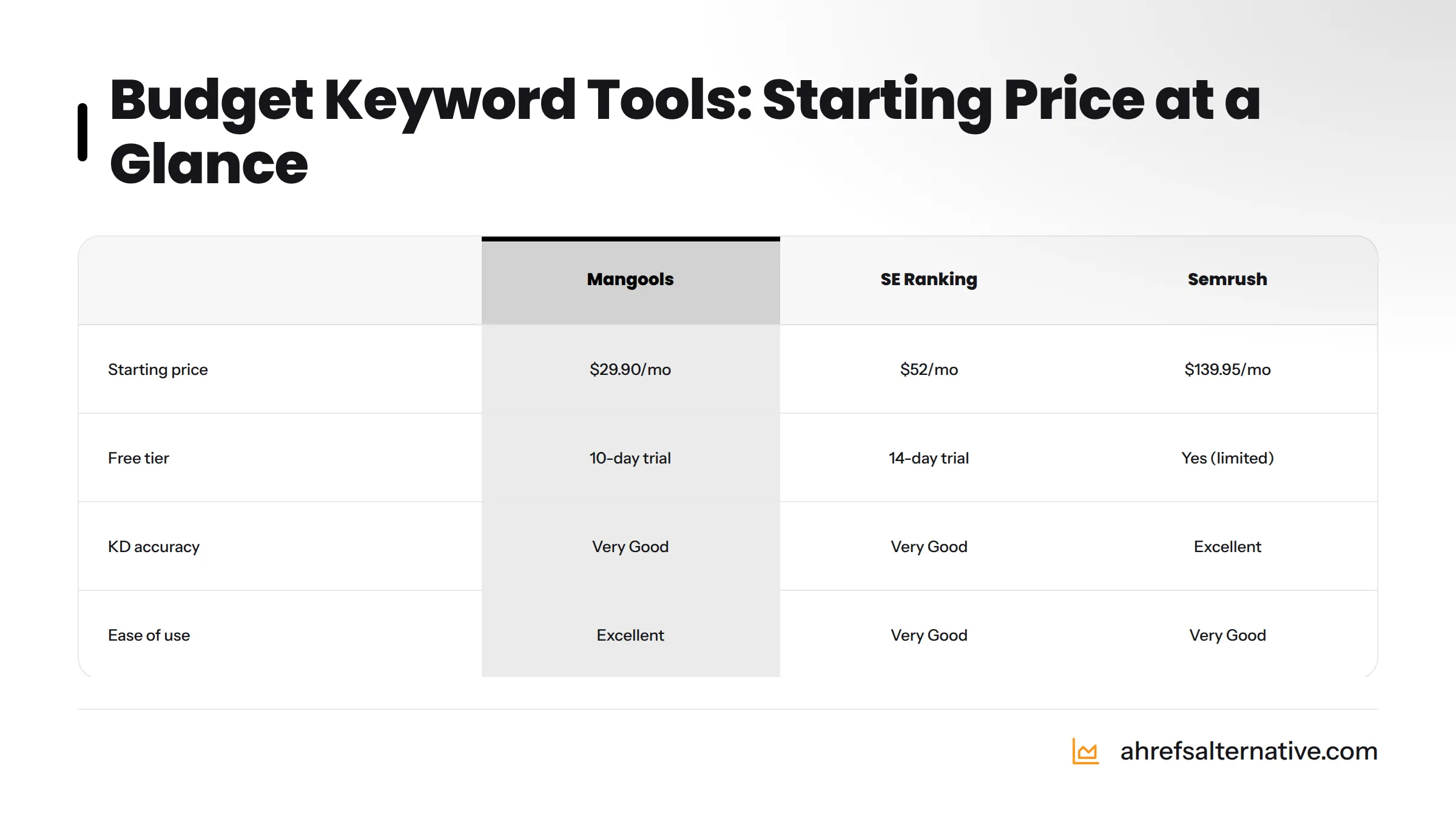
| Mangools (KWFinder) | Beginner-friendly KW research | 10-day trial | $29.90/mo | Very Good | Excellent | ⭐⭐⭐⭐½ |
| KeySearch | Ultra-affordable depth | No | $17/mo | Good | Good | ⭐⭐⭐⭐ |
| Seobility | All-in-one on tight budget | Yes (limited) | $50/mo | Good | Good | ⭐⭐⭐½ |
| Clicks.so | Budget freelancers | Limited trial | $29/mo | Good | Excellent | ⭐⭐⭐⭐ |
| SE Ranking | Competitor keyword analysis | 14-day trial | $52/mo | Very Good | Very Good | ⭐⭐⭐⭐½ |
| Serpstat | Feature-rich at mid price | 7-day trial | $59/mo | Good | Good | ⭐⭐⭐⭐ |
| SpyFu | PPC + organic research | Yes (limited) | $39/mo | Good | Good | ⭐⭐⭐⭐ |
| Semrush | Agencies and power users | Yes (limited) | $139.95/mo | Excellent | Very Good | ⭐⭐⭐⭐½ |
| Search Atlas | AI-powered keyword research | Demo available | $99/mo | Very Good | Good | ⭐⭐⭐⭐ |
Pricing verified October 2026 from official pricing pages.
Free Alternatives to Ahrefs for Keyword Research
Before spending a single dollar, you can build a surprisingly capable free keyword research setup. None of these tools individually matches Ahrefs, but used together they cover most of the core workflow.
1. Ahrefs Webmaster Tools - Best Free Option for Your Own Site
Ahrefs Webmaster Tools (AWT) is the free tier of Ahrefs itself. Verify your domain and you get access to Site Explorer data for that domain - organic keyword rankings, top pages, backlink data, and a site audit. For a blogger tracking their own site's performance, AWT delivers real value at zero cost.
What's free:
- Organic keyword rankings for your verified domains
- Backlink data for your own sites
- Site audit (up to 5,000 pages/month)
- Basic SERP position history
What's locked behind a paid plan:
- Competitor keyword research (exploring other domains)
- Keyword Explorer for discovering new keywords
- Content gap analysis against competitors
- Historical data beyond a rolling window
The honest limitation: AWT is a site monitoring tool, not a keyword discovery tool. It tells you what you already rank for. It cannot tell you what you should rank for.
2. Google Search Console - Best Free Keyword Data Source
Google Search Console (GSC) is the single most trustworthy keyword data source available at any price - because it comes directly from Google. It shows you every query that triggered an impression of your pages in Google Search, along with clicks, impressions, average position, and click-through rate.
GSC is ideal for finding keywords where you rank on page 2 and could push to page 1 with targeted content improvements. It is not a keyword discovery tool for terms you don't already rank for, and it doesn't show competitor data. Think of it as ground truth for what's already working, not a starting point for finding new opportunities from scratch.
Can you use Google Search Console instead of Ahrefs for keyword research? Yes, partially. GSC gives you real performance data for your existing content, which is irreplaceable. What it can't do is show competitor keyword gaps, generate new keyword ideas from scratch, or provide keyword difficulty scores. Use GSC as your foundation, then layer a paid tool on top when you're ready.
3. Google Keyword Planner - Best Free Tool for Search Volume
Google Keyword Planner (GKP) lives inside Google Ads and is technically free with any Google account. It gives you search volume ranges for any keyword and generates related keyword ideas - a solid starting point for building a seed keyword list.
The catch: without active Ads spend, Google shows volume as broad ranges ("1K-10K") rather than precise numbers. For competitive research or KD scoring, you'll need something else. For early-stage keyword brainstorming on zero budget, GKP remains useful and underrated.
4. Ubersuggest (Free Tier) - Best Free Keyword Ideas Tool
Ubersuggest by Neil Patel offers three free keyword searches per day without an account. Each search returns search volume, SEO difficulty, paid difficulty, CPC, and a list of keyword ideas. The free tier is limited but genuinely useful for a blogger who does keyword research once or twice a week rather than daily.
Our full review of Ubersuggest as an Ahrefs alternative covers the paid tier in detail. The free version's main weakness is the daily search cap - power users hit it within minutes.
Building a free keyword research stack: Combine GSC (performance data) + GKP (volume estimates) + Ubersuggest free (keyword ideas) + AWT (your own site's ranking data) and you cover roughly 60-70% of what Ahrefs offers for keyword research on your own site. For competitor research, you'll need to step up to a paid tool.
Budget Alternatives to Ahrefs (Under $30/month)
This is the tier that most solo bloggers, hobbyists, and early-stage freelancers should live in. You're not paying for enterprise-grade crawl budgets you won't use. You're paying for clean keyword data at a human price.
For a curated breakdown of what's worth your money here, check out 5 Cheaper Alternatives To Ahrefs You Need to Know About.
5. Mangools (KWFinder) - Best for Beginner-Friendly Keyword Research
Mangools is the tool I recommend most often to people who are new to SEO and need results fast. Its flagship product, KWFinder, pairs a clean interface with genuinely accurate keyword difficulty scores - and the learning curve is almost flat.
Enter a seed keyword, pick your target country, and within seconds you see search volume, trend data, a KD score (0-100), CPC, and a SERP preview showing the top 10 results with domain authority, page authority, backlinks, and estimated visits. That SERP preview is what sets KWFinder apart at this price point.
Mangools vs. Ahrefs for keyword difficulty accuracy: Mangools KD scores correlate well with real ranking difficulty for low-to-medium competition keywords. At high competition levels (KD 60+), Ahrefs tends to be more precise because it factors in more link equity signals. For the vast majority of keywords that bloggers and small sites target, Mangools' accuracy is more than sufficient.
Pricing: Entry plan at $29.90/month (billed monthly) or $19.90/month billed annually. Includes 100 keyword lookups and 200 keyword suggestions per 24 hours.
Free trial: 10-day free trial, no credit card required.
Pros:
- Cleanest interface of any tool in this price range
- SERP preview included at entry level
- Accurate KD for long-tail and medium-competition terms
- Includes SERPChecker, SERPWatcher, LinkMiner, and SiteProfiler
Cons:
- Daily search limits on the entry plan feel restrictive for heavy users
- Keyword database smaller than Semrush or Ahrefs
- Limited historical keyword data
Best for: Solo bloggers, hobbyists, beginners doing SEO for one or two sites.
Our dedicated Mangools Ahrefs alternative review goes deeper on the full suite. And if you're considering whether Mangools itself might need a replacement someday, the Best Mangools Alternatives page has you covered.
6. KeySearch - Best Ultra-Affordable Ahrefs Alternative
KeySearch is the best-kept secret in budget SEO tooling. At $17/month (or $169/year), it delivers keyword difficulty scores, search volume, competitor analysis, rank tracking, and a content assistant in a single dashboard. Nothing else at this price comes close for sheer breadth of functionality.
KeySearch pulls data from multiple sources including its own database and Google autocomplete, giving you solid long-tail keyword suggestions even for niche topics. The KD score methodology is transparent: it's based on a combination of domain authority, page authority, and backlinks of the top 10 results - similar in concept to Ahrefs' methodology, executed at a fraction of the cost.
Pricing: $17/month or $169/year. No credit card free trial, but a 30% discount code "KSDISC" is publicly available via the site's affiliate program.
Pros:
- Lowest price of any fully functional keyword research tool
- Includes rank tracking, competitor research, and content optimization
- YouTube keyword research included
- Solid long-tail discovery
Cons:
- Interface feels dated compared to Mangools
- Database coverage is thinner outside English-speaking markets
- No SERP preview as visually polished as KWFinder
Best for: Budget-conscious bloggers, affiliate marketers, solo founders who need full functionality without the price tag.
Read the full KeySearch Ahrefs alternative breakdown for a side-by-side feature analysis.
7. Seobility - Best for All-in-One SEO on a Tight Budget
Seobility leads with its site audit capabilities, but its keyword research module is more capable than most people realize. The free plan includes a website analysis for one domain and basic keyword monitoring. The Premium plan at $50/month includes a keyword ranking tracker, on-page analysis, and keyword research access.
For small businesses running a single website who want one tool to handle auditing, rank tracking, and basic keyword research without juggling multiple subscriptions, Seobility is a practical choice. It is not primarily a keyword discovery tool, so pair it with Google Keyword Planner or the Ubersuggest free tier for new keyword ideas.
Pricing: Free plan (1 website, limited). Premium at $50/month. Agency plan at $200/month.
Pros:
- Strong site audit at every tier
- Free plan meaningful enough to test before buying
- Clean, readable reporting
Cons:
- Keyword discovery is limited compared to KWFinder or KeySearch
- Database size is smaller than mid-range competitors
- Best value for site health monitoring, not pure keyword research
Best for: Small business owners managing one site who want audit and keyword tracking in one subscription.
The Seobility Ahrefs alternative page has a full feature breakdown if you want to dig in further.
8. Clicks.so - Best for Budget-Conscious Freelancers
Clicks.so is a newer entrant built specifically for freelancers and small agencies who need client-ready keyword research without paying agency-tier prices. It offers keyword research, rank tracking, and site auditing in a single dashboard at $29/month for the entry plan.
What makes Clicks.so worth including: the per-project structure makes client management cleaner than most budget tools, and the keyword data is sourced from a live database rather than cached snapshots. Freelancers doing keyword research across multiple client sites will appreciate not having to hack around single-domain limitations.
Pricing: Entry plan at $29/month. Higher tiers available for more projects and users.
Pros:
- Multi-project structure designed for freelancers
- Clean, modern interface
- Keyword research, rank tracking, and auditing in one plan
Cons:
- Smaller keyword database than mid-range tools
- Less established than Mangools or KeySearch in terms of track record
Best for: Freelancers managing multiple client sites who want one budget-friendly platform.
See the full Clicks.so cheapest Ahrefs alternative review for a pricing tier breakdown.
Mid-Range Alternatives ($30-$100/month)
Step up to this tier and the keyword databases get significantly larger, accuracy improves, and features like competitor gap analysis and bulk keyword exports become standard.
If you're scaling past one site or starting to do SEO work commercially, this is where you belong. For context on the value these tools deliver relative to their cost, Top 5 Affordable SEO Tools to Outperform Ahrefs makes the case clearly.
9. SE Ranking - Best Ahrefs Alternative for Competitor Keyword Analysis
SE Ranking is the tool that surprises people the most when they migrate from Ahrefs. Its keyword research module includes a database of over 5 billion keywords, competitor keyword gap analysis, a SERP analyzer, and historical ranking data. The Keyword Grouper tool - which automatically clusters keywords by topic - is something Ahrefs charges significantly more to approximate.
SE Ranking's pricing adjusts based on how many keywords you track. The cheapest plan starts at $52/month, but a freelancer tracking 500 keywords across several client sites stays at the lower end of the pricing band.
Our detailed SE Ranking vs Ahrefs comparison found that SE Ranking matches Ahrefs on most core keyword research tasks at roughly one-quarter of the price.
Pricing: Essential plan starts at $52/month (billed monthly). 14-day free trial available.
Pros:
- 5+ billion keyword database with strong international coverage
- Competitor keyword gap analysis on par with Ahrefs
- Keyword clustering built in
- White-label reporting for agencies
Cons:
- Interface has more depth than some users need
- Historical keyword data only goes 6 months back on entry plans
Best for: Freelancers doing competitive keyword research for clients, content marketers running keyword gap analysis.
Full details in the SE Ranking Ahrefs alternative review.
10. Serpstat - Best Ahrefs Clone at a Fraction of the Price
Serpstat is the tool people describe as "Ahrefs-like" most often, and it earns that comparison. Keyword research, site audit, rank tracking, competitor analysis, backlink analysis, and PPC research are all present. The keyword database covers 230+ regions, and the SERP analysis tool shows a full breakdown of the top 10 results for any keyword - including estimated traffic, domain strength, and page-level metrics.
Serpstat's keyword difficulty score has historically been slightly more generous (i.e., shows lower difficulty) than Ahrefs on competitive terms - keep that in mind when interpreting scores above KD 50.
Pricing: Individual plan at $59/month (billed monthly). 7-day free trial available.
Pros:
- Most Ahrefs-like feature set at this price point
- Strong SERP analysis with competitive intelligence
- 230+ region database
- Batch analysis for bulk keyword research
Cons:
- KD scores can underestimate difficulty on high-competition terms
- UI can feel cluttered when you first log in
Best for: Content marketers who want Ahrefs-level features without the Ahrefs price tag.
The Serpstat Ahrefs alternative page breaks down every major feature side-by-side.
11. SpyFu - Best for PPC + Organic Keyword Research
SpyFu takes a different angle from most keyword research tools. It specializes in competitive intelligence, showing you every keyword a competitor has ever ranked for organically and every keyword they've ever bought in Google Ads. If your keyword research overlaps with paid search strategy - which it should if you're doing any PPC work - SpyFu delivers insight that pure SEO tools miss.
The Kombat feature lets you enter multiple competitor domains and see the keyword overlap and gap between them, which is a fast way to identify untapped keyword opportunities.
Pricing: Basic plan at $39/month. Professional plan at $79/month. Annual plans offer significant discounts.
Free tier: SpyFu offers a limited free view - you can search any domain or keyword and see a snapshot of data before paying.
Pros:
- Unmatched competitor keyword history (going back years)
- PPC keyword data included at every tier
- Kombat competitor overlap tool is genuinely unique
- Unlimited searches on paid plans
Cons:
- Organic keyword data less comprehensive than Semrush or SE Ranking
- Interface is dated
- Less useful for pure organic keyword discovery vs. competitive intelligence
Best for: Freelancers and marketers working across SEO and PPC who need deep competitor keyword history.
Browse the SpyFu Ahrefs alternative review for a full competitive intelligence breakdown.
Full-Suite Alternatives ($100+/month)
If you're running an agency, managing SEO across 10+ sites, or need enterprise-grade data accuracy, this tier is where you operate. These tools don't just replace Ahrefs - in specific use cases, they beat it.
12. Semrush - Best Ahrefs Alternative for Agencies and Power Users
Semrush is the most direct full-feature competitor to Ahrefs. Its Keyword Magic Tool contains over 25 billion keywords across 142 countries - the largest keyword database of any tool reviewed here. Search volume, keyword difficulty, intent classification, SERP feature flags, and question-based keyword variants are all presented in a single, well-organized view.
Is Semrush better than Ahrefs for keyword research? For pure keyword volume and breadth of discovery, Semrush's database is larger. Ahrefs edges it on SERP-level competitive analysis and link-based KD accuracy. For agencies that need both keyword discovery at scale and strong content marketing features - topic research, content templates, SEO writing assistant - Semrush is the stronger all-around platform.
Pricing: Pro plan at $139.95/month (billed monthly), Guru at $249.95/month, Business at $499.95/month. A limited free plan is available (10 queries/day with restricted results).
Pros:
- Largest keyword database in the industry (25+ billion keywords)
- Best-in-class keyword intent classification
- Content marketing toolkit included in Guru and above
- Strong position tracking and local SEO features
Cons:
- More expensive than Ahrefs at higher tiers
- Free plan is very restricted
- Feature depth can overwhelm newer users
Best for: Agencies, in-house SEO teams, and content marketers who need the biggest possible keyword database with intent data.
Full review at Semrush Ahrefs alternative.
13. Search Atlas - Best for AI-Powered Keyword Research
Search Atlas by LinkGraph layers natural language processing into its keyword discovery and content planning workflow. Its Keyword Researcher tool generates topically clustered keyword sets, and its AI-driven content planning features build out content outlines based on the semantic relationships between terms - not just search volume rankings.
For a content marketer building a topical authority strategy, Search Atlas is genuinely ahead of the curve. It identifies keyword clusters that belong together from a topic modeling perspective, which saves hours of manual organization work.
Pricing: Starter plan at $99/month. Growth plan at $199/month. Custom enterprise pricing available.
Free option: A demo is available; no public free tier for keyword research.
Pros:
- Best AI-assisted keyword clustering of any tool tested
- Topical authority planning built in
- Strong keyword intent detection via NLP
- SERP data included
Cons:
- Higher price floor than most alternatives
- Less established brand recognition than Semrush or Ahrefs
- Some features still maturing
Best for: Content marketers and agencies building content around topical authority rather than individual keyword targeting.
The Search Atlas Ahrefs alternative page covers the full AI keyword planning workflow.
Which Ahrefs Alternative Is Right for You?
Here is the user persona matching matrix. Find your situation, pick your tool.
| User Type | Budget | Primary Need | Recommended Tool | Why |
|---|---|---|---|---|
| Solo blogger / hobbyist | Free | Basic keyword ideas | AWT + GSC + GKP stack | Zero cost, covers your own site well |
| Solo blogger / hobbyist | Under $30/mo | Beginner-friendly KW research | Mangools (KWFinder) | Cleanest interface, accurate KD, SERP preview |
| Freelancer (1-3 clients) | $30-$60/mo | Competitor keyword analysis | SE Ranking or Clicks.so | Multi-project, competitor gap analysis |
| Freelancer (multiple clients) | $30-$80/mo | PPC + organic research | SpyFu | Competitor history, unlimited searches |
| Startup founder | $17-$30/mo | Affordable depth, one niche | KeySearch | Lowest price, sufficient depth for focused niches |
| Small business owner | $50/mo | Audit + keyword tracking | Seobility | All-in-one without complexity |
| Content marketer | $59-$100/mo | Keyword clusters, gap analysis | Serpstat or Search Atlas | Best feature-to-price ratio for content strategy |
| Agency owner | $100-$200/mo | Scale, database size, reporting | Semrush | Largest database, best reporting suite |
Solo Bloggers and Hobbyists
Start free. Build the GSC + GKP + Ubersuggest free tier stack described above. When that starts limiting your research - usually after three to six months of active content publishing - upgrade to Mangools at $29.90/month. The 10-day free trial means you can test it with real keywords before paying anything.
Freelancers
Freelancers need multi-client flexibility and competitor keyword data. SE Ranking at $52/month is my first recommendation: the white-label reporting alone saves time, and the keyword gap analysis is strong enough to justify the cost as a client deliverable. If you work across SEO and PPC, SpyFu's Basic plan at $39/month is worth adding. For freelancers just starting out, the Best SEO Tools for Freelancers (2026 Guide) walks through the full toolkit.
Startup Founders
Founders doing their own SEO need depth without distraction. KeySearch at $17/month gives you enough keyword data, difficulty scoring, and rank tracking to build a content strategy from scratch. When you need to hand SEO off to a hire or agency, SE Ranking scales with you. The Top 5 Affordable SEO Tools for Startups (2026) covers the full decision in more depth.
Small Business Owners
Small business owners typically need keyword research for one primary site plus local keyword tracking. Seobility at $50/month covers site health, rank tracking, and basic keyword research in one clean dashboard. For businesses with a content-first growth strategy, SE Ranking is worth the extra spend. See Cost-Effective SEO for Small Businesses in 2026 for a budget allocation framework.
Content Marketers
Content marketers need keyword clusters, not just individual keywords. Serpstat at $59/month handles cluster analysis well. Search Atlas at $99/month does it with an AI assist that genuinely speeds up content planning. Both beat Ahrefs on price for this specific use case.
Agency Owners
Semrush at $139.95/month on the Pro plan or $249.95/month on Guru. The database size, white-label reporting, and breadth of features justify the cost when you're billing clients. If budget pressure is real, SE Ranking's Agency plan is a credible alternative at a lower price ceiling.
How to Do Keyword Research Without Ahrefs (Step-by-Step)
This workflow works with any tool listed above. Swap in whichever tool fits your budget tier.
Step 1 - Define Your Keyword Research Goals
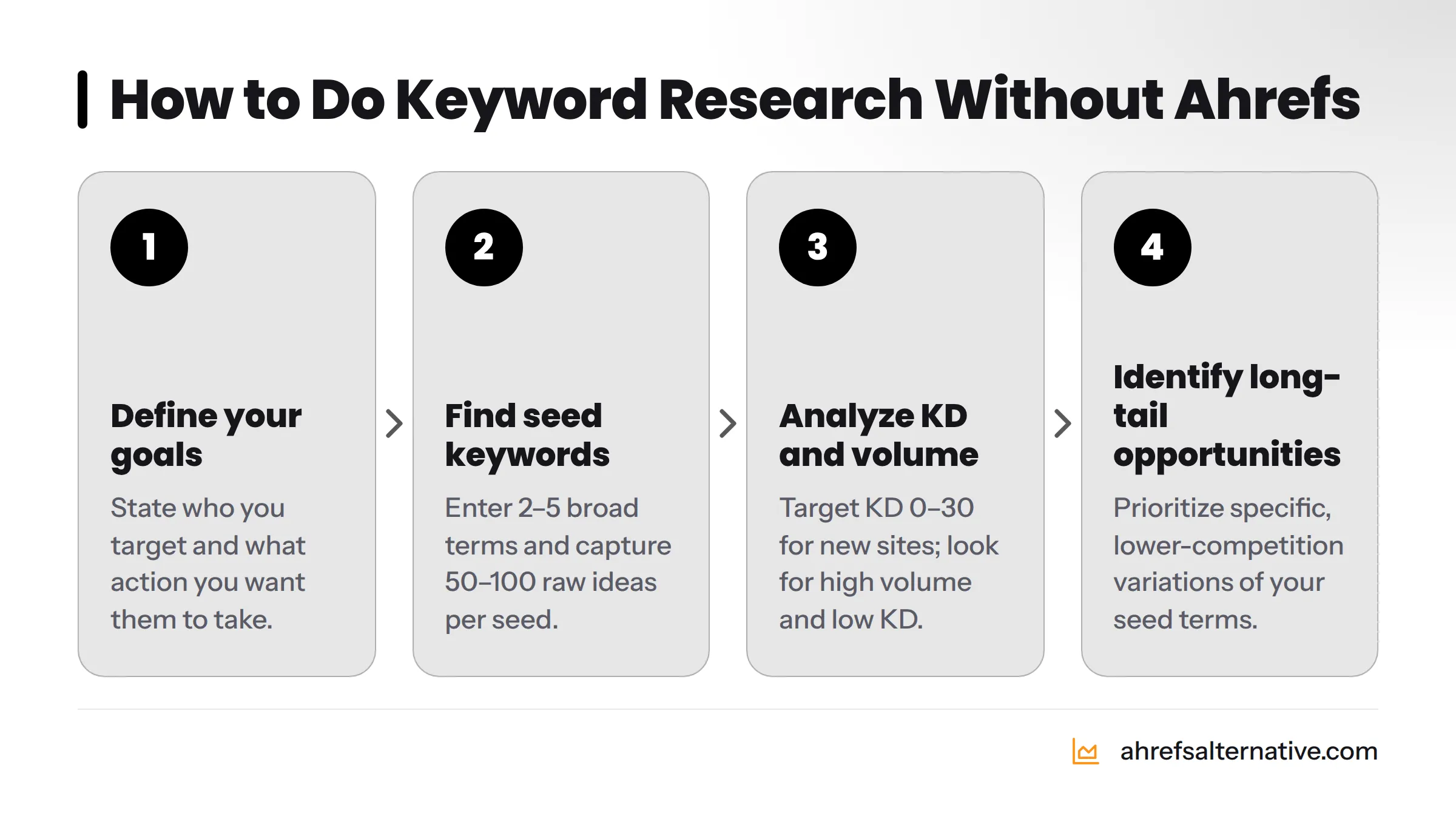
Before you search for a single keyword, write down two things: who you're targeting and what action you want them to take. A keyword list built for a product page looks completely different from one built for a blog post. Be specific. "Rank for coffee grinder keywords" is not a goal. "Find 20 low-KD keywords that a buyer searching for their first burr coffee grinder would use" is a goal.
Step 2 - Find Seed Keywords
A seed keyword is a short, broad term that defines your topic space. Enter two to five seed keywords into your tool of choice (KWFinder, SE Ranking, Semrush, etc.) and record every suggested variation. Use Google Autocomplete and the "People also ask" box to supplement tool-generated ideas - these surface real questions in plain language.
Quick checklist:
- List 3-5 broad seed terms
- Run each through your keyword tool
- Capture 50-100 raw keyword ideas per seed
- Add autocomplete and PAA results to your list
Step 3 - Analyze Keyword Difficulty and Search Volume
Keyword difficulty (KD) measures how hard it is to rank in the top 10 results for a given term. Most tools score KD from 0 to 100. For a new site (under 6 months old), target KD 0-30. For a site with some authority (6 months to 2 years), KD 30-50 is realistic. For established sites, KD 50+ becomes attainable with the right content.
Search volume is the average monthly number of searches for a keyword. High volume + low KD = the sweet spot. A keyword with 500 searches/month and KD 20 is often more valuable than one with 10,000 searches/month and KD 75.
Step 4 - Identify Long-Tail Opportunities
Long-tail keywords are phrases of four or more words with lower search volume but much higher specificity. They almost always carry lower KD, and they attract searchers who know exactly what they want - which means higher conversion rates for commercial content.
In any keyword research tool, filter your results by keyword length (4+ words) and KD under 30. You'll find dozens of opportunities your competitors have overlooked. KeySearch, SE Ranking, and Semrush all have explicit long-tail filtering.
Step 5 - Evaluate Search Intent
Search intent answers the question: what does this searcher actually want?
- Informational: They want to learn ("what is keyword difficulty")
- Navigational: They want a specific site ("Ahrefs login")
- Commercial: They're comparing options ("best Ahrefs alternatives")
- Transactional: They're ready to buy ("buy Mangools plan")
Match your content type to the intent. Writing a sales page for an informational keyword, or a blog post for a transactional keyword, wastes effort. Semrush and SE Ranking both label intent automatically. For tools that don't, check the SERP manually - the content format of the top 5 results tells you the intent clearly.
Step 6 - Build and Prioritize Your Keyword List
Export your filtered keyword list to a spreadsheet. Add columns for KD score, monthly search volume, intent type, and content type (blog post, landing page, product page). Sort by KD ascending, then prioritize by business relevance. The keywords at the top of your prioritized list become your content calendar.
Final keyword list checklist:
- Remove irrelevant keywords manually
- Assign intent to each remaining keyword
- Group related keywords into topic clusters
- Assign each cluster to a content type
- Order clusters by KD (lowest first) for sequenced publishing
Switching from Ahrefs to an Alternative - What to Do First
Switching tools feels disruptive, but the process is straightforward if you approach it in the right order.
Export Your Existing Keyword Data from Ahrefs
Before canceling or downgrading your Ahrefs subscription, export everything:
- Export your tracked keywords from Rank Tracker (CSV)
- Export keyword rankings from Site Explorer > Organic Keywords (CSV)
- Export your keyword lists from Keywords Explorer
- Export top pages data for your domain
- Screenshot or export any competitor keyword gap reports you reference regularly
- Download backlink data for your own site (you'll lose easy access once you downgrade)
Ahrefs stores your data on their servers, not locally. Once you cancel, historical data from your account disappears. Export everything before you touch the billing settings.
Replicate Your Core Reports in the New Tool
In your new tool:
- Add your domain and verify ownership (SE Ranking, Serpstat, Semrush all require this for your own site data)
- Import your tracked keyword list from Ahrefs CSV into the new rank tracker
- Run a keyword gap analysis against your top two competitors to identify ranking opportunities you need to carry forward
- Set up the same keyword clusters you were working from in Ahrefs
Set Up Rank Tracking in Your New Platform
- Add all tracked keywords to the new rank tracker
- Set tracking frequency (daily is available on most mid-range tools)
- Connect Google Search Console so the new tool pulls GSC data alongside its own crawler data
- Set up alerts for significant rank changes (most mid-range tools support email notifications)
Allow 2-3 weeks of data accumulation before comparing the new tool's rankings to what you saw in Ahrefs. Crawl timing and data freshness differ between platforms, and initial discrepancies are normal.
Frequently Asked Questions
The best free alternative to Ahrefs for keyword research is a three-tool stack: Google Search Console for performance data on your existing content, Google Keyword Planner for search volume estimates, and Ahrefs Webmaster Tools for site-level data on your own verified domains. Together they cover roughly 60-70% of Ahrefs' keyword research capability at zero cost.
Mangools KWFinder's keyword difficulty scores are accurate for low-to-medium competition keywords (KD 0-55 range), which covers the majority of opportunities available to bloggers and small sites. Ahrefs tends to be more precise at the high-competition end (KD 55+) because its KD calculation draws on a deeper link database. For most users targeting realistic keywords, the difference is not meaningful enough to justify Ahrefs' price premium.
Partially. Google Search Console shows you every keyword your site already ranks for, which is invaluable for content optimization. What it cannot do is generate new keyword ideas, show competitor keyword data, or provide keyword difficulty scores. Use GSC as a performance layer on top of a discovery tool, not as a standalone keyword research solution.
KeySearch at $17/month is the cheapest fully functional keyword research tool available. It does not match Ahrefs' database size, but it covers keyword difficulty, search volume, long-tail discovery, and rank tracking for any niche. SE Ranking at $52/month comes closest to Ahrefs-level depth at a fraction of the full cost.
Semrush has a larger keyword database (25+ billion keywords vs. Ahrefs' estimated 20+ billion) and better keyword intent labeling. Ahrefs has stronger SERP-level competitive analysis and link-based keyword difficulty scoring. For pure keyword discovery volume, Semrush wins. For understanding why specific pages rank, Ahrefs has an edge. The right choice depends on whether your work is more discovery-focused or competitive-analysis-focused.
You can replicate these Ahrefs features for free using the tools described in this guide:
- Organic keyword rankings for your site - Ahrefs Webmaster Tools + Google Search Console
- Search volume data - Google Keyword Planner
- Keyword idea generation - Ubersuggest free tier (3 searches/day)
- Site health audit - Ahrefs Webmaster Tools (500 URLs/month) + Seobility free plan
- Backlink overview for your own site - Ahrefs Webmaster Tools + Google Search Console (linking sites report)
What you cannot replicate for free: competitor keyword gap analysis, bulk keyword research at scale, and historical ranking data for competitor domains.
SE Ranking and Semrush both excel at long-tail discovery because of their database depth and filtering options. For budget users, Mangools KWFinder surfaces strong long-tail suggestions through its autocomplete-based idea generator. KeySearch also performs well for English-language long-tail research. The key feature to look for is a "related keywords" or "questions" filter - any tool with this filter will surface usable long-tail opportunities.
Yes. Search Atlas by LinkGraph offers the most developed AI-assisted keyword clustering and content planning of any tool reviewed here, using natural language processing to group keywords by topical relevance rather than just surface-level similarity. Semrush has incorporated AI writing and content optimization features into its Guru and Business plans. SE Ranking has added AI-assisted content tools to its platform as of 2026. Mangools and KeySearch remain primarily data-driven tools without significant AI layers.
The Best Ahrefs Alternatives for Keyword Research in 2026 - Final Verdict
After testing every tool on this list against real sites and real keywords, here is where I land:
| User Type | Top Pick | Runner-Up | Price |
|---|---|---|---|
| Free / zero budget | GSC + GKP + AWT stack | Ubersuggest free | $0 |
| Solo blogger | Mangools (KWFinder) | KeySearch | $17-$29.90/mo |
| Freelancer | SE Ranking | Clicks.so | $29-$52/mo |
| Startup founder | KeySearch | Mangools | $17/mo |
| Small business | SE Ranking | Seobility | $50-$52/mo |
| Content marketer | Serpstat | Search Atlas | $59-$99/mo |
| Agency | Semrush | SE Ranking | $52-$139.95/mo |
No single tool beats Ahrefs in every dimension. That's not the point. For the specific use case of keyword research - finding the right terms, understanding the competition, and building a content strategy - you can match 80-90% of Ahrefs' output at 10-40% of its price. Most readers of this guide will find everything they need somewhere between KeySearch and SE Ranking.
To explore the full directory of tested alternatives with category filters and pricing comparisons, visit Browse All Alternatives To Ahrefs on our site. Every tool section above also links to a dedicated review page with full feature breakdowns.
Keyword research without Ahrefs is not a compromise. For most users, it's the smarter move.
Sources
- Ahrefs Pricing Page - Ahrefs
- Google Search Console - Google
- Google Keyword Planner - Google Ads
- Seobility Pricing - Seobility
- Clicks.so Pricing - Clicks.so
- SE Ranking Pricing - SE Ranking
- SpyFu Pricing - SpyFu
- Semrush Pricing - Semrush
- Search Atlas Pricing - LinkGraph / Search Atlas
- Natural Language Processing - Wikipedia
- Ubersuggest - Neil Patel
- Ahrefs Webmaster Tools - Ahrefs